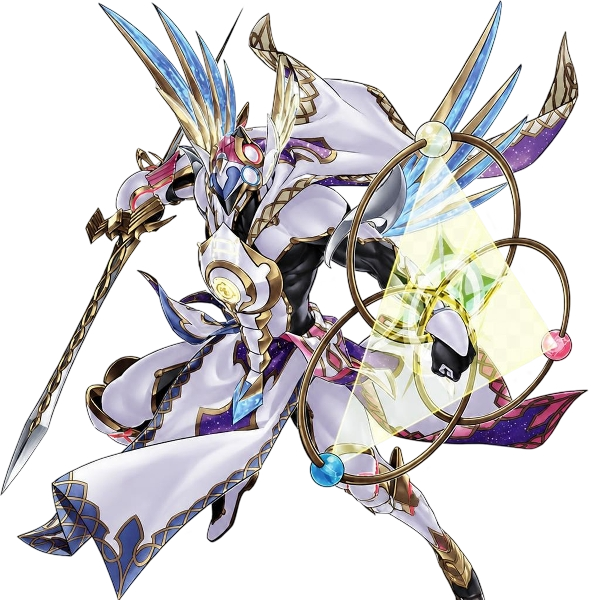
The most flexible Rank-4 Deck in all of Yu-Gi-Oh🔗
Throughout the years, this deck has had many identities. It started as a backrow control deck with the classic "Deneb set 4 pass" setup in 2015, evolved into a Link-focused Deck that abused Stellarknight Delteros' non-OPT floating effect (if sent from the Field to the GY), then leaned into it even more with the release of the Cyberstorm Access (CYAC) wave of support. Only a few months later, the deck became even combo-heavy with the addition of the Armored Engine which let you loop Delteros even more often and enabling you to make any board in the game you wished for if you were uninterrupted.
The newest wave of support in Glorious Gallery was a clear signal from Konami: Delteros looping is this Deck's identity. Nothing made this clearer than the release of Tellarknight Constellar Delteros. A retrain of Stellarknight Delteros, it's a simple card without any hard once-per-turn on it: an Ignition effect that searches any of this deck's monsters and immediately Normal Summons a LIGHT monster (giving Floowandereeze a run for their money) and a Trigger effect that lets you summon a name from your Hand or Banishment when it hits the GY from anywhere BUT the field. Since the deck can abuse these effects multiple times, Tellarknight Constellar Delteros becomes an absolute powerhouse of a playmaker.
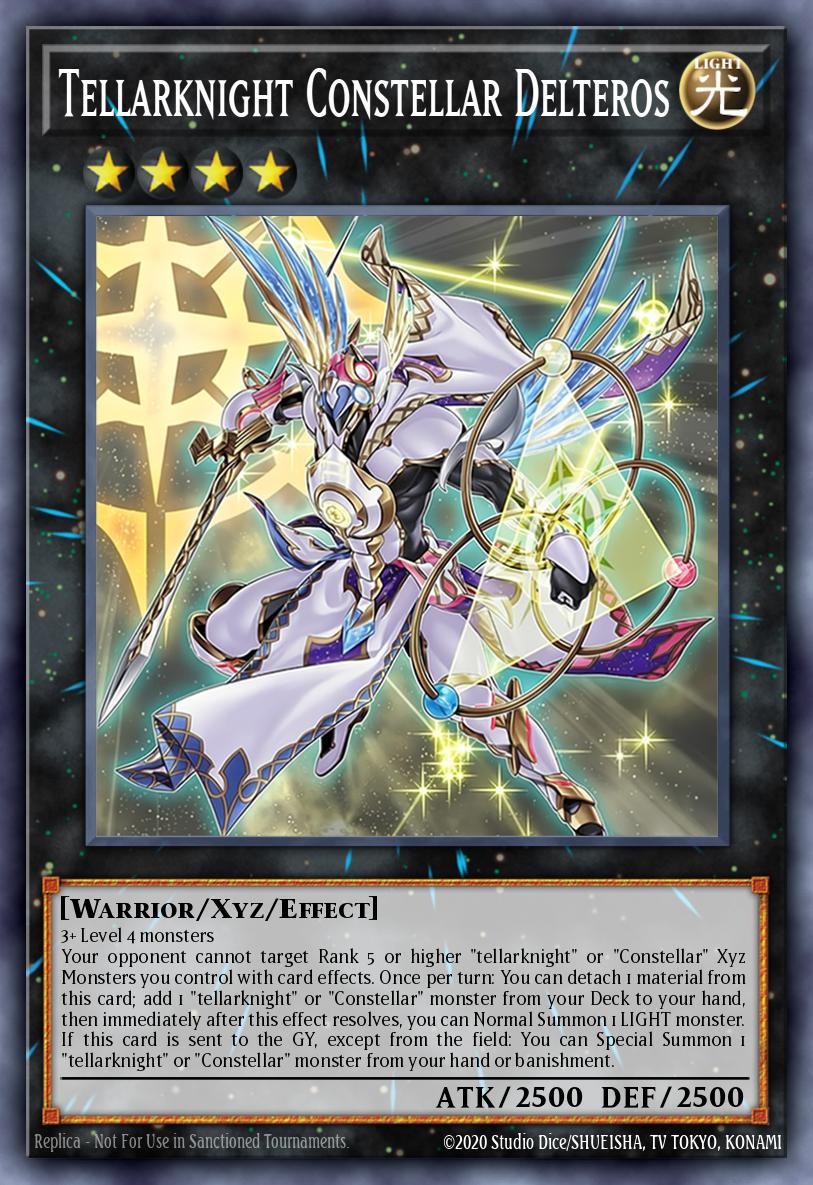
Tellarknights, Constellar, what's the difference?🔗
At first glance, all of these constellation-themed cards may look the same and they bear striking similarities in terms of design to each other. Be at ease, for there's not a lot that separates these two archetypes.
At the beginning of the Hidden Arsenal release, Constellar was a standalone archetype of cards, all with on-summon effects that either searched or summoned another Constellar card from your hand. Later on in Duelist Alliance (DUEA), Konami printed a series of completely independent "Tellarknight" cards, which also all had on-summon effects. However, those functioned more like a toolbox, with effects ranging from foolishing a Tellarknight Card, to reborning 1, to discarding 1 to draw a card etc.. Most of these cards were called "Satellarknight" or "Stellarknight", but since all Tellarknight cards (except for one extra Deck monster) always specify "tellarknight" in their effect texts, the Sa- and S- prefixes were ignored for the most part.
Only with the later support wave in CYAC did Konami print Tellarknight cards with text on them that made them also be treated as Constellars. They continued that trend with nearly all of the newest cards in Battles of Legend: Glorious Gallery (BLGG). And with those new cards powercreeping most of the old one-archetype-only cards, barely any cards from the first releases of both archetypes still see play. Notable exceptions of those being specifically Satellarknight Altair, Satellarknight Unukalhai and Constellar Sombre.
TLDR: What is my goal with the deck? I thought it was just turnskip turbo🔗
You might have heard of this Deck from some YouTubers or locals players showing a crazy turnskip combo. Yes, the Deck can turnskip and it can be a viable option to go into depending on the matchup, but the lines required to do so are fragile and can lead to a loss against a single well-placed handtrap. What this deck can also do is put up an incredibly resilient endboard even when up against a floodgate handtrap such as Droll, Nibiru or even Dimension Shifter. Because it is a combo deck, it has a strong weakness against all 3 of the Mulcharmy cards.
I get it, teach me the usual lines for a typical endboard🔗
Okay! Let's make it real simple and use the best starter of the Deck. 90% of the lines will have you do the following:
- Normal Summon Constellar Castor, use its effect
- Special Summon Tellarknight Cygnian from Deck, use its effect to search Constellar Caduceus
- Special Summon Constellar Caduceus from your Hand, use its effect to search Constellar Tellarknights
- Overlay Cygnian and Castor for Tellarknight Constellar Delteros
- Use its effect and detach Cygnian to search and normal summon Tellarknight Altairan
- Overlay Altairan and Caduceus for Tellarknight Constellar Caduceus
From here the lines diverge a bit depending on what you want to play around. But usually the standard lines typically end on something like this:
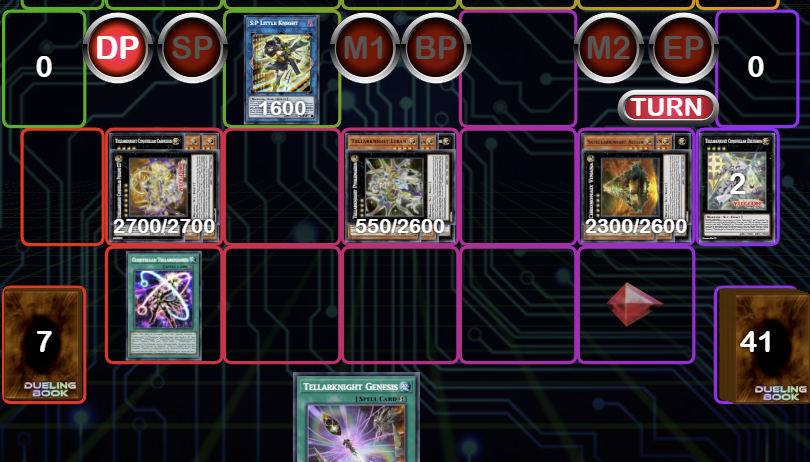
Believe it or not, this is a total of 9 interactions. All of it with the standard 1-card combos being able to play after a Nibiru and the 2-card combos being able to put up a negate on summon 5 already. As you can see, the Deck has very powerful lines available from its individual cards.
The Turnskip🔗
So you want to learn how to turnskip with the Deck? Ok, but beware: Most of the time its better to go for a proper Endboard rather than committing to the turnskip. The turnskip will burn a lot of resources and grind game, and if your opponent can stop it on the chokepoint (Ptolemaeus), you will most likely lose.
How can I even get 7 materials under Ptolemaeus?🔗
Simple: Overlay all 5 monsters in your main monster zones into either Tellarknight Constellar Caduceus or Tellarknight Constellar Delteros, then rank it up into Constellar Ptolemy M7 and use the continuous effect of the Constellar Tellarknights spell to rank-change into Tellarknight Ptolemaeus. That's 7 materials!
Now, since Ptolemaeus is the chokepoint, if she gets imperm'd, Dominus Sparked, Nibiru'd or if Constellar Tellarknights gets Ghost Ogre'd, Ghost Belle'd, or Dominus Impulsed you've likely lost. Yikes! That's a lot of outs your opponent can throw against it. So...
When should you turnskip?🔗
Option A: You're under Fuwalos.🔗
Let's face it, any standard Tellar combo will give your opponent more draws than you can put up interruptions. Now if you're unlucky and did not draw Ash or Called By The Grave you're stuck with having to commit into either a half-board... or we say f- it, GO BIG OR GO HOME, TURNSKIP TIME BABYYYYY.
If you get Fuwalos'd, the typical turnskip line leading from Constellar Castor will give your opponent a total of 8-9 draws. With both Castor and Lyran in the hand we can reduce that number to 5 draws. That's still a lot and the chance that your opponent draws an interruption for the turnskip is 81.8%, assuming they have 6 outs in their deck for it (or 55.6% for 3).
So statistically you're really just gambling. Sub-engines such as Magnet Warriors or Onomat can help reduce that number further (to perhaps only providing 3-4 draws depending on the hand).
Option B: Your opponent plays Board Breakers.🔗
Luckily, Yu-Gi-Oh is a game that is usually played in a Best-Of-3 format. After Game 1, you should have enough knowledge to know if your opponent plays a more board breaker heavy-approach. Use your best judgement and only turnskip if you're sure that your opponent will not side-in cards such as Nibiru to stop you.
What can we do into the Charmies?🔗
Tellarknight has a very strong engine but it Special Summons from every zone in the game (including Banishment now). Hence, there's only a limited amount of outs to Charmies. Here are some points to what you can do to play into / around them better:
Play Ash, Called By and Droll in the Main Deck🔗
These are the maximum amount of outs you can play. You can also play a larger Fairy Engine (see Decklists) in order to play the Heralds and avoid having to deal with them.
Play Droll and Artifact Durendal🔗
Now Droll might be dependant on the meta, however it enables a "fun" interaction. With only 2 draws, you can handloop your opponent using Artifact Durendal and Droll! Simply follow this combo:
- Normal summon Constellar Castor (Fuwalos is dropped here)
- Castor Special Summons Tellarknight Cygnian which searches you Constellar Caduceus.
- Special Summon Caduceus and search Constellar Tellarknights and set it.
- Use Tellarknight Cygnian to modulate Castor into level 5, overlay both for Artifact Durendal
- Use its effect as Chain Link 1 to shuffle your and your opponents' hands into the deck by detaching Cygnian, then use Droll as Chain Link 2.
Since the chain resolves as much as possible, this will lead to both you and your opponent losing your entire hands. However... you have a secret spell hidden in the backrow that you can simply flip up to reborn the material you just detached! Now you can simply overlay both for a rank-4 of your choice and keep playing and make your standard anti-droll endboard! Powerful eh?
Turnskip🔗
See the section above for details!